Home>Product Information>Steel Belt Machine

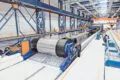
Steel Belt Machine

Belt Cooler

To correspond to the characteristic of the material and the shape of the product, the belt cooler is utilized in combination with various feeding devices and after-treatment equipment. Incase of treating low-viscosity liquid material, side-sealing device is installed on the belt edge.

Applications Cooling, solidification and pastillation of various resins, chemicals and foodstuffs.
Descriptions Molten material supplied from reactor, extruder or kneader is cooled in form of sheet, strand or pastille on a belt or between two belts by pressing and taken out solid product.

NR Type Double Belt Cooler

Feed material is rolled out in form of sheet by press rolls at entrance via steel betls and then cooled in close contact with both upper and lower belts. This cooler can be used even for the material of high viscosity max. 100,000m Pa.s.

NR Type Double Belt Cooler

NR Type Double Belt Cooler

delivery experience Max. viscosity : ~ 1,000,000mPa・s
Max. capacity : ~ 5,000kg/hr

Single Belt Cooler

Single type cooler is suitable for cooling of liquid materials of low viscosity, low specific-heat materials, low thickness membrane materials and shaped materials like pastilles.

Single Belt Cooler

Single Belt Cooler

Double Belt Cooler

Normally, preliminary device like overflow feeder or press rolls are necessary at the entrance. This cooler is suitable for low or medium viscosity materials.

Double Belt Cooler

Double Belt Cooler

SC Type Belt Cooler

This is the space-saving and compact type cooler by the combined design of cooling drum and steel belt. This cooler is recommendable for R&D use or pilot scale production.

SC Type Belt Cooler

SC Type Belt Cooler

Belt Film Caster

Belt Film Caster

By supplying Berndorf Belt renowned with world highest technology level for quality of super mirror-polished surface. It enables to meet requirement of the film for optical IT industry which is in the forefront of technology. Also we are able to make solution for the requirement of operating conditions and production capacity by our know-how for deciding the belt width and length. For the machine design, we are able to provide the facility engineering know-how of our parent company, or test performance by test machine. Therefore, the technical specifications are determined on custom-made basis by joint work between our customer and us.

Applications Production of film or sheet.
Descriptions Liquid material is fed on the mirror-polished steel belt where evaporation of solvent or polymerization takes place, and thus film or sheet product is obtained.

Double Belt Press (DBP)

Double Belt Press (DBP)

DBP machines are used in diverse applications such as polymeriazaion of synthetic resin in sheet form, heat treatment of plastic sheet, vulcanizaion of rubber sheet, lamination of two or more sheet materials or production of composite sheet consisting of fibrous materials and plastics. For the machine design, we are able to provide the facility engineering know-how of our parent company, or test performance by test machine. Therefore, the technical specifications are determined on custom-made basis by joint work between our customer and us.

Photo sauce: from MEC pamphlet

Applications Heat treatment, sheet formation, or lamination of plastics, rubbers, or composite sheets.
Descriptions One or plural pieces of sheet material(s) are supplied between upper and lower steel belts and heated and/ or cooled under pressure in flat conditions.

Belt Polymerizer

Belt Polymerizer

Applications Production of polymer materials like polymeric adhesive agents or super water-absorbent resins.
Descriptions Monomer or oligomor syrup is supplied upon the steel belt, and polymerization reaction takes place continuously. Belt running area consists of heating section and cooling section to control polymerization reaction by spraying warm water or cooling water to the inside of the belt.

Belt Dryer

Belt Dryer

Applications Drying or aging of sludge, paste or wet materials in powder, flake, fiber, or sheet form.
Descriptions Materials are efficiently dried by passing drying air through perforated belt. In case of using non-perforated belt, materials are dried by passing hot air on the product surface side, and also dried from the inside surface side using the best heat method as hot air, or hot water, or electric heat. Due to using the steel belt, high temperature drying is possible.
Page Up